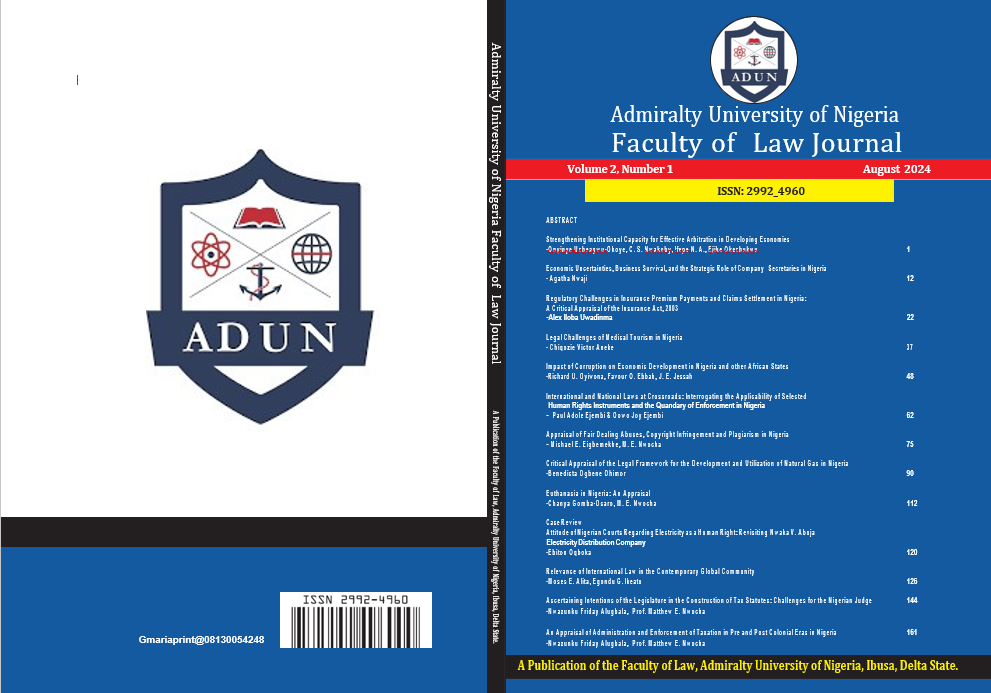
Case Review Attitude of Nigerian Courts Regarding Electricity as a Human Right: Revisiting Nwaka V. Abuja Electricity Distribution Company
Keywords:
Electricity Access, Human Rights, Institution, Courts, CommunityAbstract
It has been argued that when it comes to human rights performance compared to other countries in
Sub-Saharan Africa, Nigeria is performing worse than average. The Country scored 54.6per cent
for the right to food, 48.7per cent for right to health, 35.7 per cent for the right to housing and 32.0
per cent for the right to work.1 Nigerians are still struggling with poor electricity services; there is
need to improve this situation. The Courts will be required to treat access to electricity as a form of
human rights. This piece reviewed the decision of the court in Dr. N. Nwaka v. AEDC. It concludes
by stating that the court adopted a narrowed view of the provisions of section 42 of the Constitution
and argues that the court should subsequently adopt a broader view in ensuring that consumers can
enforce access to electricity as a human right.
Downloads
Downloads
Published
Issue
Section
License
Copyright (c) 2024 ADMIRALTY UNIVERSITY OF NIGERIA FACULTY OF LAW JOURNAL

This work is licensed under a Creative Commons Attribution 4.0 International License.
By submitting an article to the Admiralty University of Nigeria Faculty of Law Journal, the author(s) have agreed to assign copyright in the article to the Faculty of Law, Admiralty of Nigeria, Ibusa, Delta State, Nigeria, although views expressed in the articles are those of the author(s). Therefore, permission for reproduction of the article must be with the written consent of the Journal Publisher.
 Print: